
Overview

When Lumos discovers accounts from multiple sources (e.g., Okta sync and a CSV upload) and matches these accounts to a User, it uses a priority system to determine the final Account Status displayed for the Account in the UI. This article explains how that works and highlights common scenarios that can cause confusion.

How Account Status is Determined

When multiple found accounts exist for the same user in the same app, Lumos uses a two-step priority system to determine Account Status.
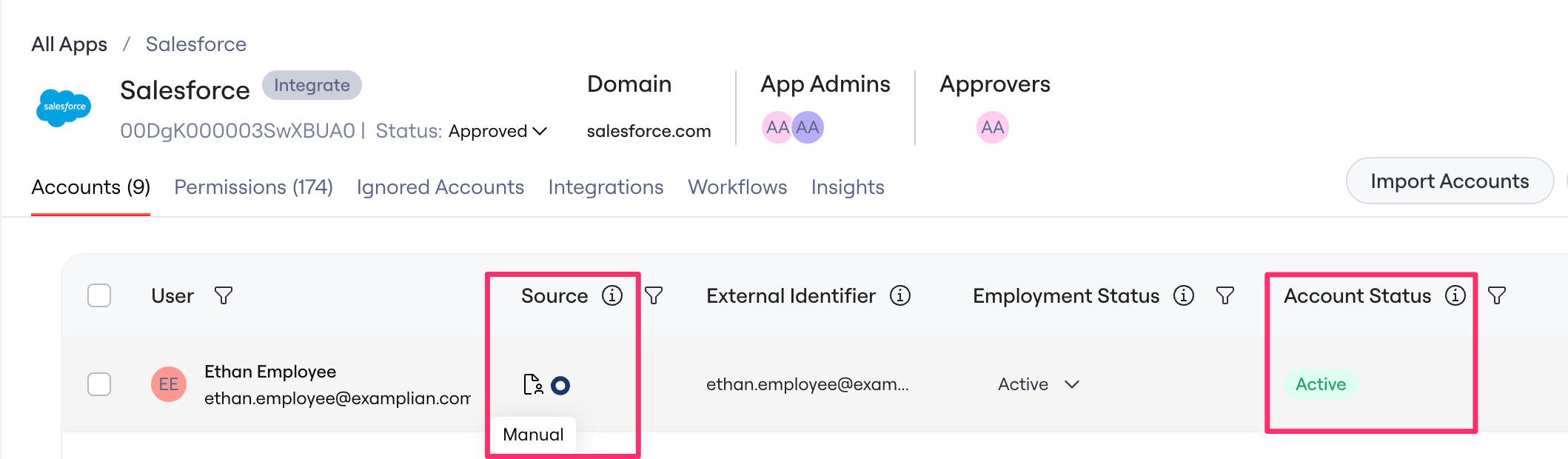
Screenshot_67-2.png

Step 1: Source Priority

Lumos first ranks found accounts by their app source:

Step 2: Status Priority (Tiebreaker)

If multiple found accounts have the same source priority, Lumos selects the status that indicates the user has access. Why?
From a security and compliance perspective, it’s better to over-report access than under-report it. If even one source says a user has access, Lumos displays them as having access until all sources confirm they don’t.

Example

If:
  • An Okta found account shows SUSPENDED
  • A CSV-uploaded found account shows ACTIVE
Then:
  • Both sources have priority 1 (tie)
  • ACTIVE wins because it indicates the user may still have access
  • Result: Account displays as ACTIVE

FAQs

Why does an account still show as ACTIVE when I already removed it from Okta? Okta is a priority 1 source. If the account was also discovered through another priority 1 source (like a CSV upload) or a higher-priority source (like a direct Lumos integration) that still reports it as ACTIVE, the consolidated Account Status will remain ACTIVE. Check all sources contributing to the account to confirm the removal is reflected everywhere. Lumos intentionally over-reports access. If even one if one app source says a user has access, the account displays as ACTIVE until all sources agree they don’t. I uploaded a CSV with updated statuses, but nothing changed. Why? CSV uploads are priority 1, the same as delegated sources like Okta. If a direct Lumos integration (priority 0) already reports a status for that account, the integration’s status takes precedence regardless of what the CSV says. Why did a User with a Suspended Okta account match for an Inactivity Workflow? Inactivity workflows evaluate accounts based on their consolidated Account Status, not the status from any single source. They target accounts with an Active status (ACTIVE, STAGED, ACCESS_CREATED, or DISCOVERED). So if the user’s Okta found account is SUSPENDED but another source with equal or higher priority still reports the account as ACTIVE, the consolidated Account Status will be ACTIVE — and the account becomes eligible for the Inactivity Workflow.