

↳ Title
↳ Team
↳ Manager
Entitlements Structure: Identity → Accounts → Entitlements → Resources This guide provides an overview of the Lumos object model and explains how to effectively model entitlements within the system. Understanding these concepts is crucial for architects and administrators implementing Lumos as their identity solution. Below is a conceptual model for how Lumos structures identity and entitlement data. Use this model to design how entitlements should be represented in your own organization and how data flows in and out of Lumos.
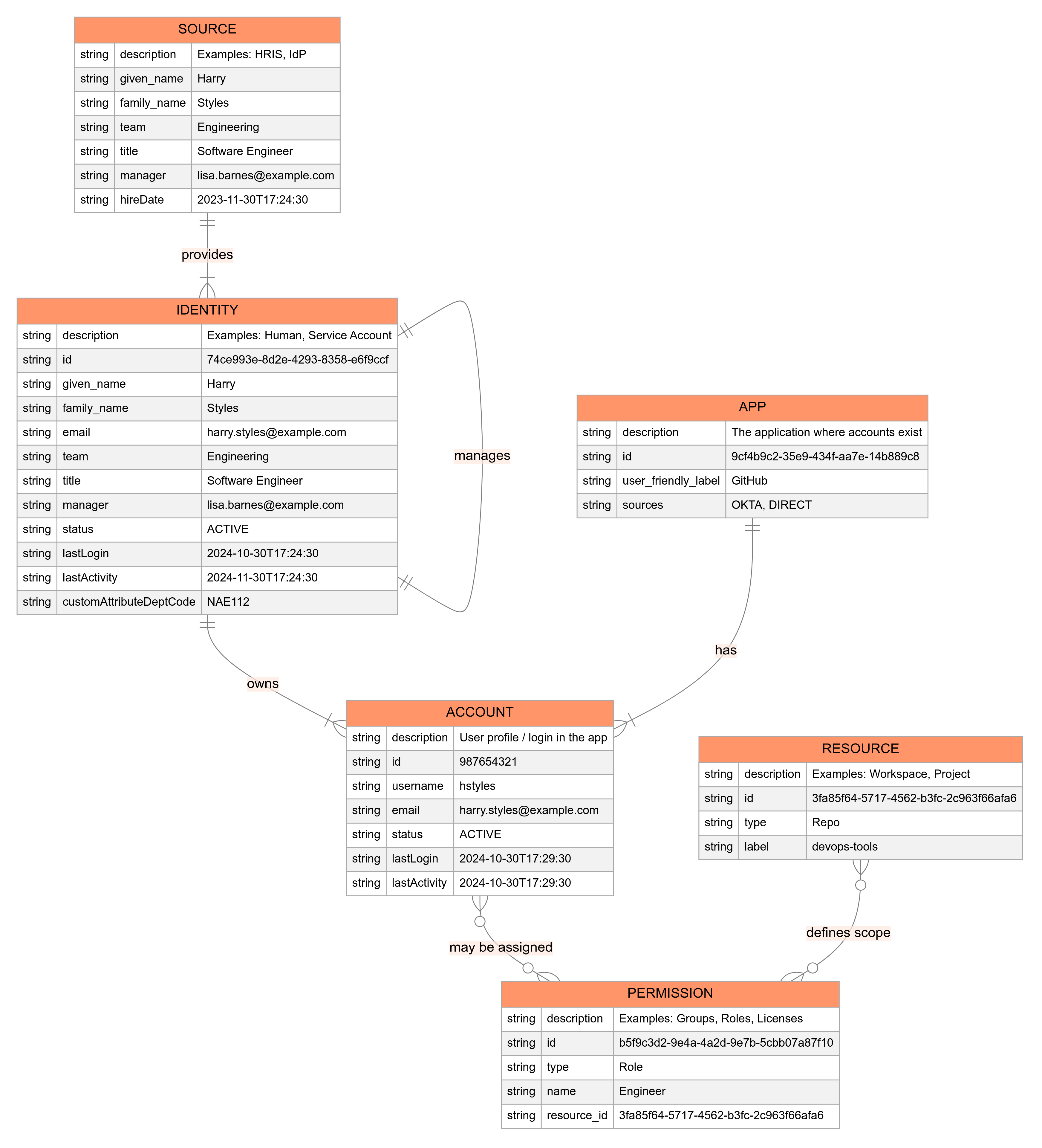
Lumos Object Model
- Human Resource Information Systems (HRIS, e.g., Workday, UKG, ADP, BambooHR, etc.)
- Identity Providers (IdP, e.g., Okta, Microsoft Entra ID, OneLogin, etc.)
- Directories (e.g., Active Directory, OpenLDAP)
- Custom HR Systems
- Unique identifier
- Basic profile information (name, email, etc.)
- Employment details (hire date, termination date)
- Organizational context (team, title)
- Reporting relationships (manager)
- Account status (active, inactive, suspended)
- Last Login
- An Identity can have multiple Accounts across different systems
- Accounts are linked to their parent Identity
- Each Account contains system-specific attributes
- Account status (active, inactive, suspended)
- Last Login and Last activity
- Associated with one Identity, but can exist in multiple apps.
- An access right, role, license, or group that can be assigned/unassigned to an account.
- Examples: Slack “channel membership,” O365 “license: E3,” GitHub “org role: admin.”
- Typically discovered by Lumos using list_entitlements.
- Contextual grouping or container. For example, in Slack, a resource might be a specific workspace. In AWS, a resource might be an AWS account or a region.
- list_resources enumerates these.
- Identity → Account: A single identity can have multiple accounts across different systems.
- Account → Entitlements: A single account can have multiple entitlements.
- Resource → Entitlements: Some entitlements belong to a specific resource context (e.g., a role within a specific AWS account).